
Treatment of laryngeal paralysis in an 8-year-old dog using a silicone laryngeal stent
When we talk about laryngeal paralysis in dogs, we often think of an obvious diagnosis. But in clinical practice, the signs can be progressive, intermittent, and easy to confuse with other respiratory causes.
This is what Aurora's story shows us (image 1).
In this article, we share his progress and how, thanks to the work of veterinarian Dr Diego Lima (Brazil), the case was treated with a minimally invasive and effective option: an ABTVet silicone laryngeal stent, available in Brazil through Eurogreen, our distributor.

Aurora's case: a tracheostomy and a hoarse bark
Aurora was born on 30/01/2018
From late 2019 to early 2020, she began to develop strange skin lesions: they would appear and disappear, and any small scratch could develop into more serious lesions, with infections and complications.
In August 2020, Aurora had an acute respiratory episode with very low oxygenation, requiring oxygen and, subsequently, a tracheostomy due to complications. After the surgery, she returned to a normal life (playing, going for walks, good tolerance), although with a hoarse bark.
Over time, that hoarse bark developed into noisy and progressively more difficult breathing.
Aurora's transition from snoring to stridor
Over the years, her respiratory symptoms changed:
The initial hoarseness turned into stridor/breathing noise (video 1)
In September 2025, her inspiratory effort increased significantly.
During episodes of emotional distress, Aurora developed lingual cyanosis (purple tongue), a clear warning sign.
Finally, in November 2025, laryngoscopy confirmed the diagnosis: laryngeal paralysis, with surgical indication.
Placement of a silicone laryngeal stent to treat laryngeal paralysis
Laryngoscopy revealed inadequate opening of the larynx during inspiration, consistent with laryngeal paralysis. In such cases, the clinical priority is clear:
Restore airflow
Reduce respiratory effort
Prevent acute crises due to stress/heat/excitement
Improve quality of life without adding unnecessary morbidity
On 12 January 2026, under the supervision of Dr Diego Lima (Brazil), a silicone stent prosthesis was fitted (image 3).

This is where the approach changes the prognosis: instead of more invasive strategies or more complex recovery, the ABTVet silicone laryngeal stent allows the airway to be kept open mechanically, with a procedure designed to be:
Minimally invasive
Quick to perform
Simple clinical concept
Aimed at getting the patient out of the emergency room by restoring airflow
Why ABTVet silicone stents can make a difference in respiratory emergencies
When a patient experiences a crisis due to functional obstruction of the upper airway, time is of the essence.
ABTVet silicone stents are designed to restore airflow by maintaining a functional lumen, helping to stabilise patients with respiratory compromise.
A stent can be a valuable tool because it focuses on the essentials: opening the airway and stabilising the patient.
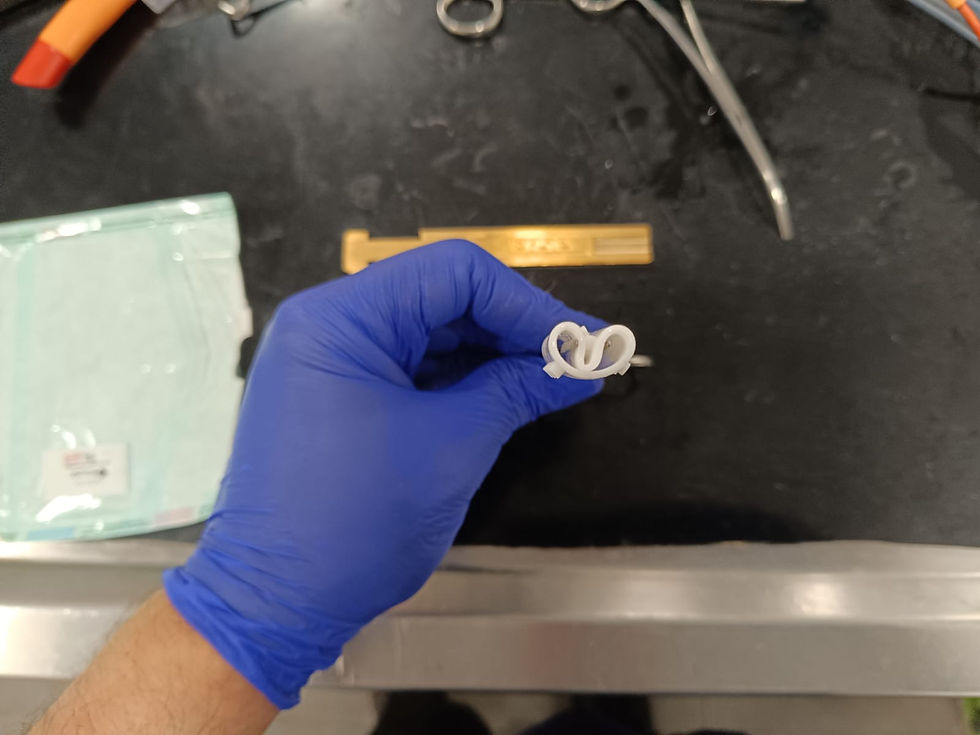
The importance of having a Starter Kit in your clinic is that you are prepared in advance to save the patient's life.
ABTvet silicone stents are designed for real respiratory emergencies (guards, heat crises, excitement).
In daily clinical practice, many cases worsen due to:
stress
high temperatures
excitement
gradual progression underdiagnosed
Having a solution ready to go can prevent the patient from “arriving late”.
ABTVet in Brazil: our distributor of silicone stents
For colleagues in Brazil, ABTVet stents are available through Eurogreen, our official distributor in Brazil, facilitating access, logistics, and support.
If you are in Brazil and would like information about:
available measures
starter kits
instructions and size selection
training and usage protocols
Eurogreen can assist you with the acquisition and initial guidance.
Thanks to Dr Diego Lima's approach and the use of an ABTVet silicone laryngeal stent, it was possible to offer an alternative focused on what matters most: restoring airflow with a minimally invasive and simple solution, especially useful when the upper airway becomes an emergency.
#LaryngealParalysis #Dogs #VeterinaryMedicine #VeterinarySurgery #VeterinaryEmergencies #Airways #VeterinaryRespiratory #Endoscopy #Laryngoscopy #SiliconeStent #LaryngealStent #ABTVet #Eurogreen #VeterinaryBrazil #ClinicalCase


Comments